
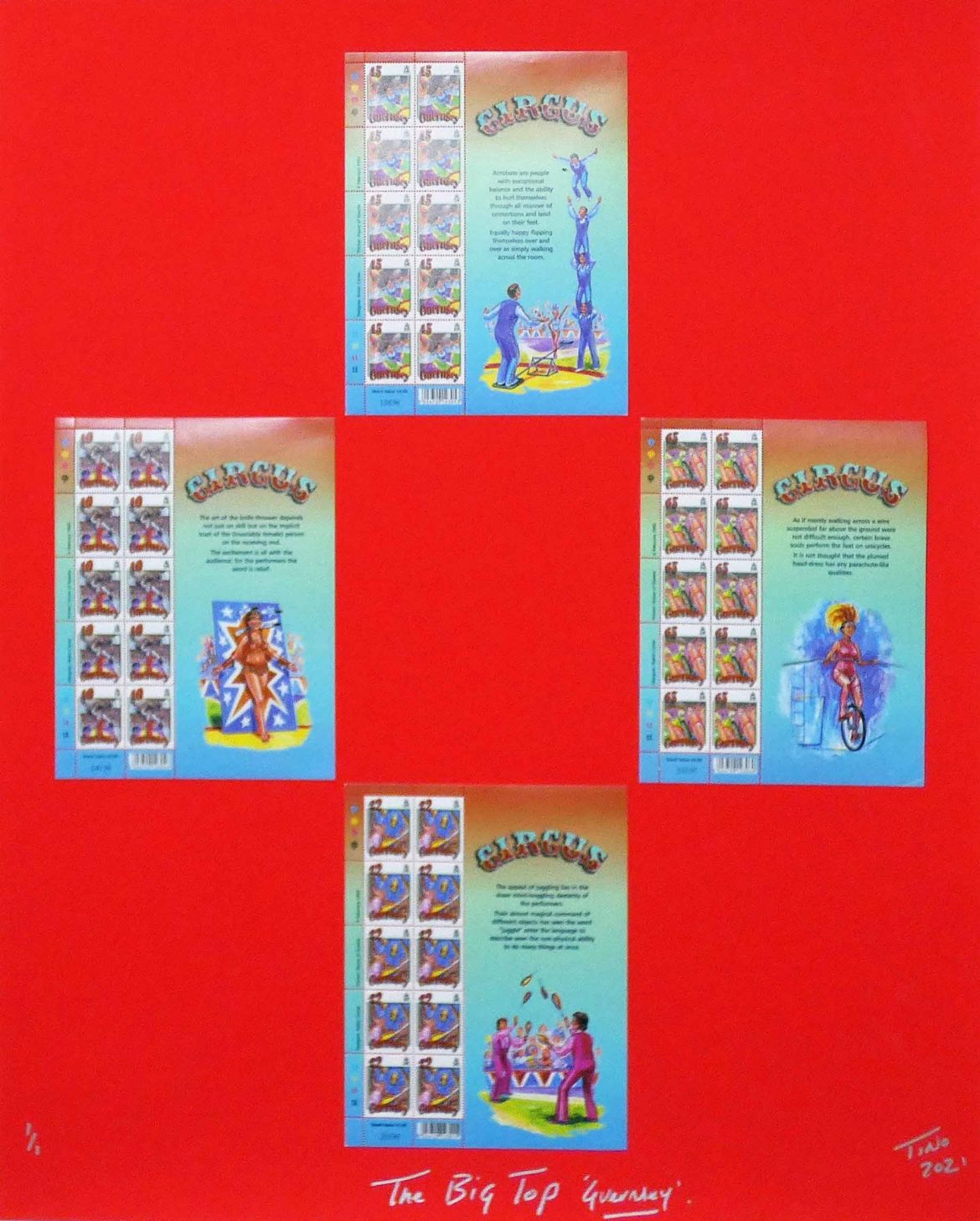
The Stamp Art ‘Big Top’ project, presents an informative and educational showcase of Europa 2002 – The Circus, Famous Clowns Stamp Issue. The showcase of Stamp Art is a display of story telling, presented in Artwork Layouts with a number of ‘Limited Edition’ Fine Artwork prints available with Mint Stamps for sale in the Stamp Art Gallery Shop.
The Europa 2002 theme is ‘The Circus, famous clowns’ featuring Joseph Grimaldi (1778-1837) the most celebrated of English clowns, born in London, son of an Italian father and English mother; Swiss clown ‘Grock’ Karl Adrien Wettach (1880-1959); ‘Coco the clown’ Nicholai Polakovs OBE (1900-1974) probably most famous clown in British history, originally a Jewish Latvian and Jean Hubert Charles Cairoli (1910-1980) born in Milan of French parents.

The word ‘Carnival’ is of Christian origin, and in the Middle Ages, it referred to a period following Epiphany season that reached its climax before midnight on Shrove Tuesday.
In England, the season immediately before Lent was called Shrovetide. A time for confessing sins (“shriving”), it had fewer festivities than the Continental Carnivals. Today, Shrove Tuesday is celebrated as Pancake Day but little else of the Lent-related Shrovetide survived the 16th-century English Reformation. The Shrovetide Carnival in the United Kingdom is celebrated in Cowes and East Cowes on the Isle of Wight. Since 2012, Hastings in East Sussex has celebrated with its own Mardi Gras, or Fat Tuesday. Five days of music and street events culminating with a Grand Ball on Fat Tuesday itself. Loosely based on the New Orleans style of carnival, Hastings has taken its own course.

Many parts of Belgium celebrate Carnival, typically with costume parades, partying and fireworks.
Stamp Art Europa 2002 –
The Circus, Famous Clowns Stamp Issue

The Circus ‘Big Top’ project
The Big Top ‘ Jersey’
Size: A1
The Carnival of Binche dates at least to the 14th century. Parades are held over the three days before Lent; the most important participants are the Giles, who wear traditional costumes on Shrove Tuesday and throw blood oranges to the crowd. In 2003, the Carnival of Binche was recognised as one of the Masterpiece of the Oral and intqangible Heritage of Humanity, The Carnival of Aaist, celebrated during the three days preceding Ash Wednesday, received the same recognition in 2010.

The Circus ‘Big Top’ project
The Big Top ‘ Guernsey’
Size: A1
Conclusion
The term Carnival is traditionally used in areas with a large Catholic presence, as well as in Greece. In historically Evangelical Lutheran countries, the celebration is known as Fastelavn and in areas with a high concentration o Anglicans (Church of England/US Episcopal Church, Methodists, and other Protestants, pre-Lenten celebrations, along with penitential observances, occur on Shrove Tuesday or Mardi Gras. In Slavic Eastern Orthodox nations nations, Maslenitsa is celebrated during the last week before Great Lent. In German- speaking Europe and the Netherlands, the Carnival season traditionally opens on 11/11 (often at 11:11 a.m.). This dates back to celebrations before the Advent season or with harvest celebrations of St. Martin’s Day.
The term Carnival is interlinked with The Circus as a way to enjoy celebration and coming together to have fun and enjoyment.
Private commission for exhibition’s and corporate display, in large format artworks with accompanying messaging are available by request. Please contact info@stampartist.co.uk. for more information.
Fine Art Limited Edition & Numbered Prints
Visit The Stamp Art Shop to Explore A full range of
Fine Art Limited Edition Prints for sale.
Click the Image to go to the Shop.
* Original Stamp Artworks.
* Unique Fine Art Stamp Art Reproductions.
* Stamp Artworks with Fine Mint Stamps within the Artworks.
shop.stampartist.co.uk