
The Stamp Art British ‘Birds’ project of The 1989 GB RSPB First Day Cover issue with insert card and The GB 2010/2011 First Day Cover issue, presented in an informative and educational review of ‘Birds’ focusing on the symbolism and song of the bird, for critique and understanding. Many social species pass on knowledge across generations, which is considered a form of culture. Birds are social, communicating with visual signals, calls, and songs, and participating in such behaviours as co-operative breeding and hunting, flocking and mobbing of predators. The vast majority of bird species are socially (but not necessarily sexually) monogamous, usually for one breeding season at a time, sometimes for years, but rarely for life.
This British ‘Birds’ project is showcased in Artwork Layouts and are available for private commission, corporate showcases and exhibition’s only, in large format displays with accompanying messaging. For more information, please contact info@stampartist.co.uk.
Birds play prominent and diverse roles in religion and mythology. In religion, birds may serve as either messengers or priests and leaders for a deity, such as in the Cult of Makemake, in which them Tangata manu of Easter Island served as chiefs or as attendants, as in the case of Hugin and Munin, the two common ravens who whispered news into the ears of the Norse god Odin. In several civilisations of ancient Italy, particularly Etruscan and Roman religion, priests were involved in augury, or interpreting the words of birds while the “auspex” (from which the word “auspicious” is derived) watched their activities to foretell events.

UK Garden Birds
They may also serve as religious symbols as when Jonah (Hebrew יוֹנָה, dove) embodied the fright, passivity, mourning, and beauty traditionally associated with doves. Birds have themselves been deified, as in the case of the common peacock, which is perceived as Mother Earth by the people of southern India. In the ancient world, doves were used as symbols of the Mesopotamian goddess Inanna (later known as Ishtar), the Canaanite mother goddess Asherah and the Greek goddess Aphrodite. In ancient Greece Athena, the goddess of wisdom and patron deity of the city of Athens, had a little owl as her symbol. In religious images preserved from the Inca and Tiwanaku empires, birds are depicted in the process of transgressing boundaries between earthly and underground spiritual realms. Indigenous peoples of the central Andes maintain legends of birds passing to and from metaphysical worlds

Doves A sign of purity
Heartbreaking statistics reveal that one in four birds are now on the Red List of Conservation Concern, needing urgent conservation action. The RSBP reveals 67 Red Listed birds including puffins, turtle doves, cuckoos, skylarks, lapwings. Now seems a good time to pay attention to the long fascination that artists have had with birds. The artists in the Art UK archive have certainly put this into practice, honing in on the resplendent details of the birds they bring into being through paint.

Puffins in the wild – symbolism of self-empowerment
The stamp art birds project uses the mythology and song of The Bird to remind us of this important species of our nature. The use of Mint Stamps with splendid colours and unique ‘commemorative bird cancellations‘ remind us of their flight, tweets and calls as we admire their amazing colours and dances in flight and choose them for their pleasure and symbolic strength they bring to our lives.

The British ‘Birds’ project
The RSPB
1989 RSPB2010 British Birds First Day Cover issue with insert card – MINT
Size: 29.5cm x 42cm
PUFFINS – symbolism
Puffins have a long and mysterious folklore. During the Middle Ages it’s thought that Muslim and Jewish scholars couldn’t determine if various birds including puffins were fish or humans and called for them to be killed.
In Irish folklore, puffins are reincarnations of Celtic monks, and in the Faroe Islands they’re known as prestur – priests. The word frater, Latin for ‘brother’ is also used to mean a friar, so the genus name of puffins (Fratercula) could be interpreted as ‘little brother’ or ‘little friar’ – aided by the puffin’s colouring and solemn demeanour, especially on land, where it walks slowly with its head bowed.

The British ‘Birds’ project
1st Edition Birds 1st Cancellation Issue
2010 British Birds First Day Cover issue with insert card – MINT
Size: 42cm x 29.5cm
ROBIN – symbolism
Originally, a robin redbreast was just known as redbreast, but acquired ‘Robin’ as Victorians liked naming birds. Despite being a year-round native bird in the UK, robins are often associated with Christmas, often appearing on Christmas cards. In Victorian times postmen wore red coats, and when sending Christmas cards took off commercially in the 1860s, robins were often depicted as postmen with a Yuletide message in their bills. The Victorians even nicknamed their postmen “robins”. It may sound melancholy to us but the robin’s call has a clear purpose in autumn.

The British ‘Birds’ project
1st Edition Birds 2nd Cancellation Issue
2010 British Birds First Day Cover issue with insert card – MINT
Size: 42cm x 29.5cm
MAGPIE – symbolism
Few birds are so closely connected to superstitions and folklore than the magpie. Before the spread of Christianity the magpie was often associated with good luck or fortune. The Romans believed magpies were highly intelligent, and in Ancient Greece magpies were deemed sacred to Bacchus, the god of wine. The Church viewed the magpie very differently. It’s said that the magpie was the only bird not to go into Noah’s ark, and also the only bird not to sing to comfort Jesus on the cross or go into a proper period of mourning because of its pied plumage, which also has an association with evil and bad fortune.
In European folklore, magpies are widely perceived as being attracted to sparkly, shiny objects to steal for their nests. Whilst magpies are indeed intelligent and inquisitive, this trait has been exaggerated. Magpies are actually highly intelligent birds and can use tools, play games, work in teams, and mimic human speech.
The traditional children’s nursery rhyme “One for Sorrow” depicts an old superstition, where the number of magpies you sees tells if you will have bad or good luck.
One for sorrow,
Two for joy,
Three for a girl,
Four for a boy,
Five for silver,
Six for gold,
Seven for a secret never to be told.

The British ‘Birds’ project
1st Edition Birds 3rd Cancellation Issue
2010 British Birds First Day Cover issue with insert card – MINT
Size: 42cm x 29.5cm
SWANS – symbolism
Despite warnings they “can break your arm with their wing”, swans are often associated with grace and elegance, and as a symbol of love and fidelity due to their long-lasting, apparently monogamous relationships – swans usually mate for life.
Swans feature heavily in mythology. Leda and the Swan is a story from Greek mythology in which Zeus, in the form of a swan, seduces Leda, Queen of Sparta, conceiving Helen of Troy. The mute swan was also thought to be one of the sacred birds of Apollo, and therefore considered a symbol of harmony and beauty. Its limited capabilities as a singer were sublimated to songbirds, creating the notion of a ‘swan song’. A swan song refers to an ancient belief that upon death, a mute swan would sing a beautiful song, having been silent most of their lifetime. The story behind Tchaikovsky’s ballet and the impact it has had on those who have heard and danced to it.

The British ‘Birds’ project
1st Edition Birds 4th Cancellation Issue
2010 British Birds First Day Cover issue with insert card – MINT
Size: 42cm x 29.5cm
STORKS – symbolism
According to European folklore, storks are thought to bring babies to new parents. Although an ancient legend, this thought was popularised by a 19th-century Hans Christian Andersen story called “The Storks”.
German folklore held that storks found babies (“stork stones”) in caves or marshes and brought them to households in a basket on their backs or in their beaks. Tales such as this also helped disguise the facts of life at a time of prudery, especially in Victorian England.
The myth of storks bringing babies is probably rooted in the birds’ migration and roosting habits. In Europe, storks arrive and breed in Spring, establishing their nests on roofs and other high, prominent places where their careful parenting can easily be seen.
Conclusion
The meaning of a Bird is grace, beauty, love, trust, and loyalty. Swan symbolism is also linked to inner beauty and self love. A pair of swans represent soul mates for life. We hope this guide on swan symbolism helps you decipher your own swan meaning so you can get in touch with your powerful inner beauty and love yourself more deeply.
The Stamp Art Gallery is please to announce a special interest Artwork collection by Tino, to be exhibited as a mixed media Artwork on Canvas with accompanying literature messaging in a totally unique and new approach to entice the public into the new age of mixed media and messaging using postal stamps. Please review the Stamp Art Shop for this Artwork collection which will be publicised in the Shops press area and online through it press releases and blogs.
For private commission, corporate showcases and exhibition’s of the British ‘Birds’ project, please contact info@stampartist.co.uk. for more information.
Fine Art Limited Edition & Numbered Prints
Visit The Stamp Art Shop to Explore A full range of
Fine Art Limited Edition Prints for sale.
Click the Image to go to the Shop.
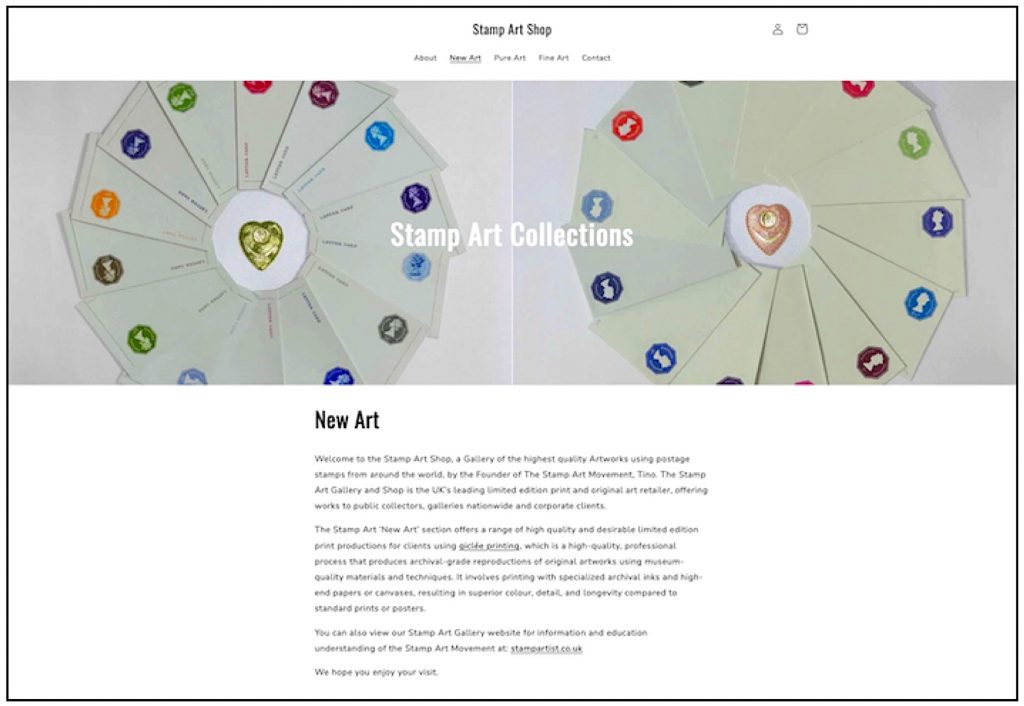
* Original Stamp Artworks.
* Unique Fine Art Stamp Art Reproductions.
* Stamp Artworks with Fine Mint Stamps within the Artworks.
shop.stampartist.co.uk