
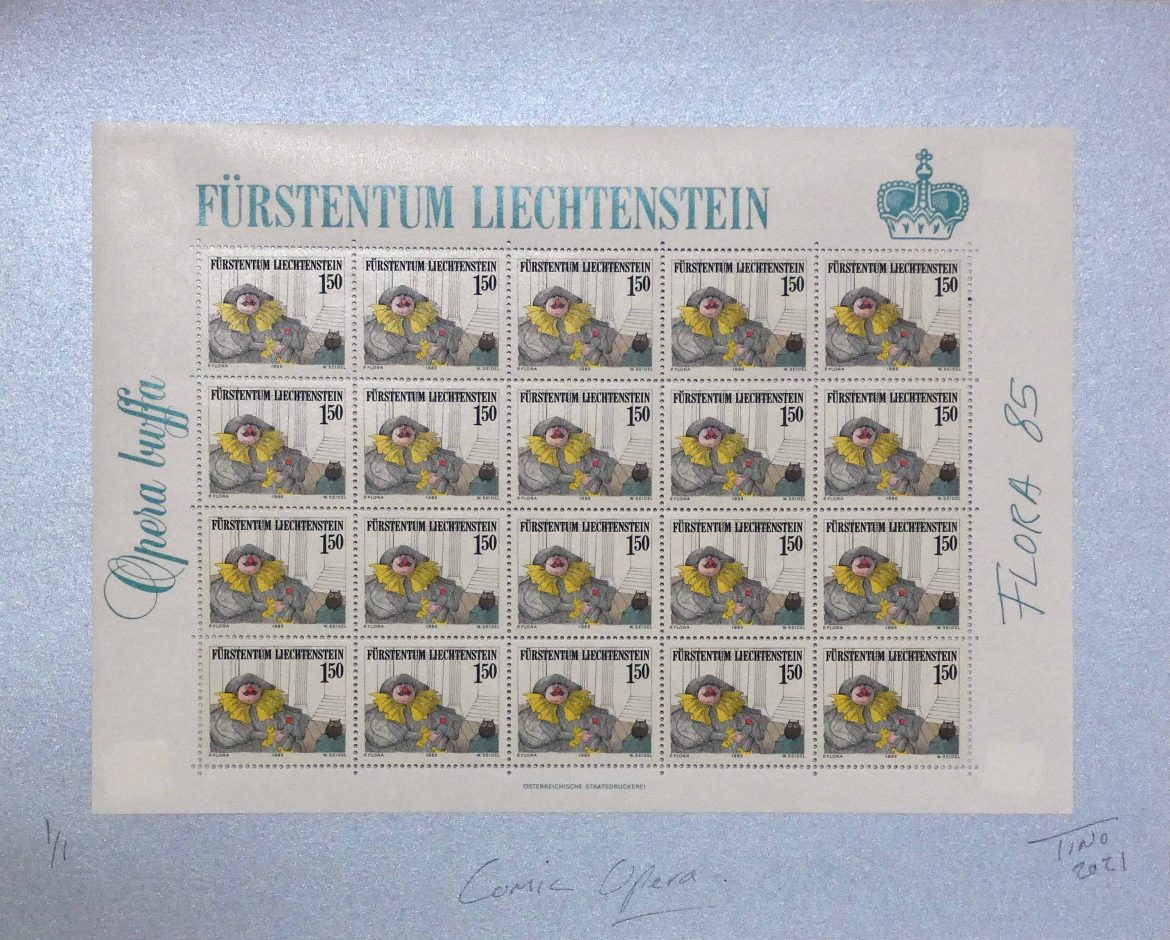
The Stamp Art Liechtenstein ‘Flora 85’ project, the setting for an Opera, presents an informative and educational review of the areas of Liechtenstein. The showcase of Stamp Art is unique in their display of story telling, presented in Artwork Layouts with a number of ‘Limited Edition’ Fine Artwork prints available for sale in the Stamp Art Gallery Shop.
The flora of Liechtenstein is divided into three areas: the Rhine Valley, the slopes and alpine regions on the Rhine Valley side, the alluvial soils and peat soils of the Rhine. For warmth-loving plants of the central area, Liechtenstein is the northern border – due to the mild foehn climate. Of the 1,600 plant species, 800 are from the mountain flora.

Flora in Liechtenstein
The occurrence of 48 orchid species and the rich natural area of the Ruggeller Riet are particularly noteworthy. 1537 is the year in which Liechtenstein was first mentioned by a botanist. The German doctor and botanist Bock. He found the European cyclamen in the Liechtenstein Oberland. From 1896 to 1900 the Austrian botanist Beck created a herbarium with 500 plants for Liechtenstein. The other names of botanists are Murr and Seitter, they each wrote a documentation on the Liechtenstein plant species. The last work comes from the Buchserin Edith Waldburger, who created a herbarium with all 1600 known plant species of the country. Of these 1600 species, 25% are on the red list of rare, endangered or extinct plants.

Alpine Flora
The bog soils give ample evidence of the post-glacial vegetation history, because pollen has been preserved in the peat for thousands of years. The most important site of this type can be found on the Schellenberg in the Rietle (near the Upper Castle). The first post-glacial tree in Liechtenstein was the birch, followed by the pine and hazel. Around 2000 BC, wheat is found, which indicates that it was colonized or used by humans. After the Ice Age, Liechtenstein was heavily forested. The tree line was at 2000 m above sea level. The beech became the strongest tree and has remained so to this day.

National Flower of Liechtenstein – The Yellow Lily
The open proximity to the Chur area brought some plants and there are also plant finds from the Seeztal valley. The Ruggeller Riet, which is often described in the literature, is worth a visit, and there are also beautiful plants along the hiking trails in the Alpine region, especially the fire lily.
Opera
Opera is a form of theatre in which music is a fundamental component and dramatic roles are taken by singers, but is distinct from musical theatre. Such a “work” (the literal translation of the Italian word “opera”) is typically a collaboration between a composer and a librettist and incorporates a number of the performing arts, such as acting, scenery, costume, and sometimes dance or ballet. The performance is typically given in an opera house, accompanied by an orchestra or smaller musical ensemble, which since the early 19th century has been led by a conductor.

Opera
The Stamp Art Liechtenstein ‘Flora 85’ project combines the beauty of the amazing alpine plant life, setting the scene for the yearly opera for locals and visitors to enjoy, surrounded by the fresh and natural wildlife as the backdrop to experience these classic operas. Displayed in full Liechtenstein ‘Flora 85’ issue of postage sheets in MINT condition capturing the expression of the opera, of the professions.

The Liechtenstein ‘Flora 85’ project
Comic Opera
Comic opera is a sung dramatic work of a light or comic nature, usually with a happy ending and often including spoken dialogue.
Forms of comic opera first developed in late 17th-century Italy. By the 1730s, a new operatic genre, opera buffa, emerged as an alternative to opera seria. It quickly made its way to France, where it became opera comique, and eventually, in the following century, French operetta, with Jacques Offenbach as its most accomplished practitioner.
The influence of the Italian and French forms spread to other parts of Europe. Many countries developed their own genres of comic opera, incorporating the Italian and French models along with their own musical traditions. Examples include German singspiel, Viennese operetta, Spanish zarzuela, Russian comic opera, English 22 Revisionsballad and Savoy opera, North American operetta and musical comedy.

troupe-Commedia-dellarte

The Liechtenstein ‘Flora 85’ project
Tragedy
Tragédie en musique, musical tragedy), also known as tragédie lyrique (French lyric tragedy), is a genre of French opera introduced by Jean-Baptise Lully and used by his followers until the second half of the eighteenth century. Operas in this genre are usually based on stories from Classical mythology or the Italian romantic epics of Tasso and Ariosto. The stories may not necessarily have a tragic ending – in fact, most do not – but the works’ atmospheres are suffused throughout with an affect of nobility and stateliness. The standard tragédie en musique has five acts. Earlier works in the genre were preceded by an allegorical prologue and, during the lifetime of Louis XIV, these generally celebrated the king’s noble qualities and his prowess in war.

Classical Tragedy Opera

The Liechtenstein ‘Flora 85’ project
Comedy of the Professions
Commedia dell’arte, (Italian: “comedy of the profession”) Italian theatrical form that flourished throughout Europe from the 16th through the 18th century. Outside Italy, the form had its greatest success in France, where it became the Comédie-Italienne.
In England, elements from it were naturalized in the harlequinade in pantomime and in the Punch-and-Judy show, a puppet play involving the commedia dell’arte character Punch. The comical Hanswurst, of German folklore, was also a commedia dell’arte character.
The commedia dell’arte was a form of popular theatre that emphasized ensemble acting; its improvisations were set in a firm framework of masks and stock situations, and its plots were frequently borrowed from the classical literary tradition of the commedia erudita, or literary drama.

Comedy of the Professions
Conclusion
The commedia dell’arte was a form of popular theatre that emphasized ensemble acting; its improvisations were set in a firm framework of masks and stock situations, and its plots were frequently borrowed from the classical literary tradition of the commedia erudita, or literary drama.
Professional players who specialized in one role developed an unmatched comic acting technique, which contributed to the popularity of the itinerant commedia troupes that traveled throughout Europe. Despite contemporary depictions of scenarios and masks and descriptions of particular presentations, impressions today of what the commedia dell’arte was like are secondhand.
The art is a lost one, its mood and style irrecoverable.
Liechtenstein’s postal stamps are famous for their exceptional artistry, high aesthetic value, and status as a vital part of the nation’s economy and identity. Since issuing its first stamp in 1912, the principality has built a worldwide reputation among collectors for masterful engraving and unique designs.
Private commission for exhibition’s and corporate display, in large format artworks with accompanying messaging are available by request. Please contact info@stampartist.co.uk. for more information.
Fine Art Limited Edition & Numbered Prints
Visit The Stamp Art Shop to Explore A full range of
Fine Art Limited Edition Prints for sale.
Click the Image to go to the Shop.
* Original Stamp Artworks.
* Unique Fine Art Stamp Art Reproductions.
* Stamp Artworks with Fine Mint Stamps within the Artworks.
shop.stampartist.co.uk