
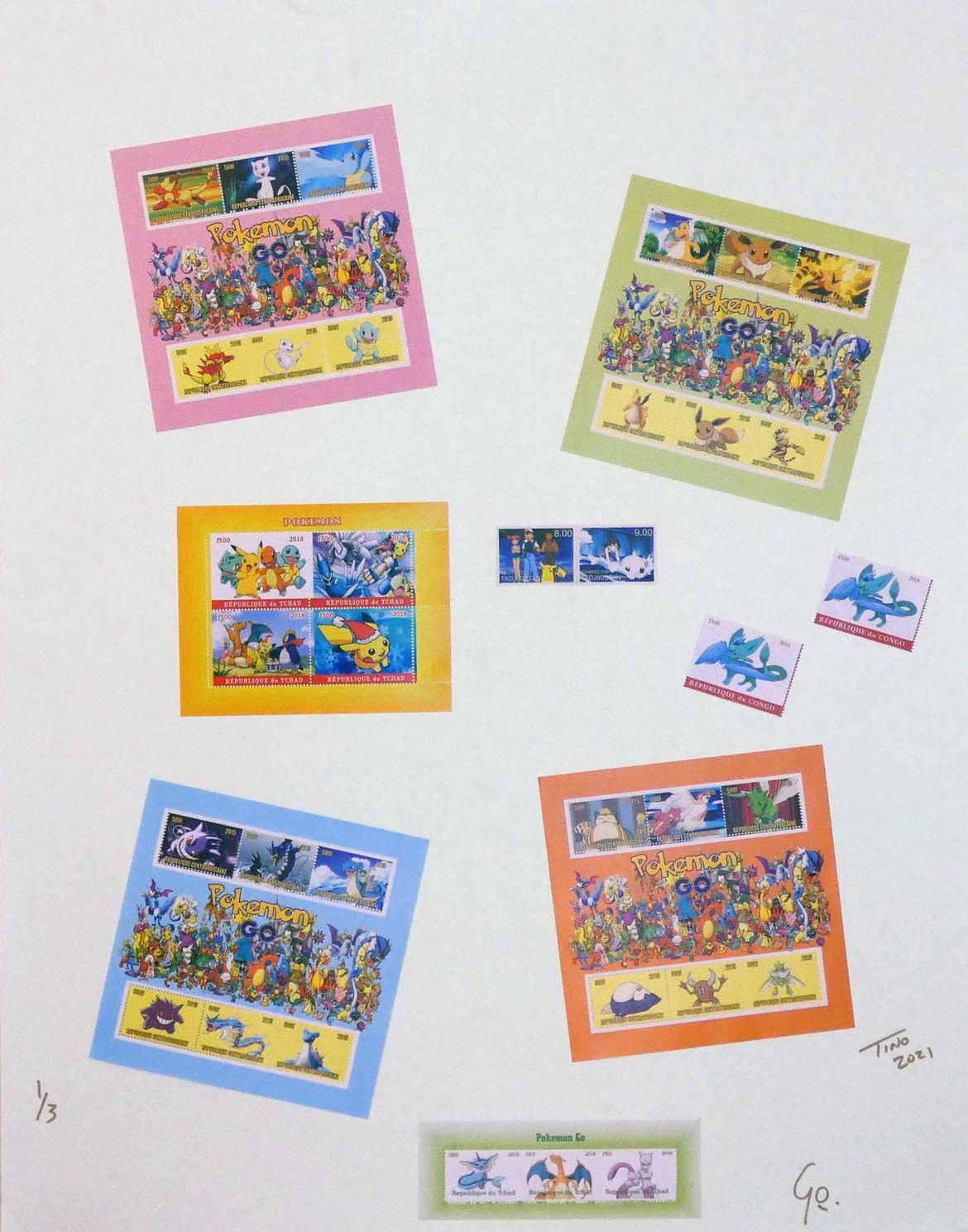
The Stamp Art Pokeman ‘GO’ project, presents an informative and educational showcase of The Nintendo Pokemon Game Stamp Issue ‘The Season of Mischief’. The showcase of Stamp Art is a display of story telling, presented in Artwork Layouts with a number of ‘Limited Edition’ Fine Artwork prints with MINT Stamps and Panes, available for sale in the Stamp Art Gallery Shop.
Pokémon Go is a 2016 augmented reality (AR) mobile game developed and published by Niantic in collaboration with Nintendo and The Pokemon Company for iOS and Android devices. A part of the Pokemon franchise, the game is the result of a collaboration between Niantic, Nintendo and The Pokémon Company.
The Season of Mischief in Pokemon Go is a game-wide season that ran from Wednesday, September 1, 2021, to Wednesday, December 1, 2021. It focused on the Mythical Pokémon Hoopa, who made its Pokémon GO debut, and featured special research, seasonal spawns, and changes to raids.
Hoopa is a Mythical Pokémon introduced in Generation VI, known for its ability to bend and warp space using its rings. It has two forms: Hoopa Confined and Hoopa Unbound. Hoopa Confined is a Psychic/Ghost type, while Hoopa Unbound, accessed by using the Prison Bottle, becomes a Psychic/Dark type with a significant increase in size and power.
In Japanese traditions mythical beliefs play a large part in society, maybe as a way to live life or to find enjoyment away from the hustle and bustle of every day work life. Shinto is one of the oldest Japanese belief systems and plays a large part in Japanese traditions.
The Stamp Art introduction to Shinto, (literally “the way of the gods”) is Japan’s native belief system and predates historical records. The many practices, attitudes, and institutions that have developed to make up Shinto revolve around the Japanese land and seasons and their relation with the human inhabitants.

Shinto does not have a founder nor does it have sacred scriptures like the sutras or the Bible. Propaganda and preaching are not common either, because Shinto is deeply rooted in the Japanese people and traditions.
“Shinto gods” are called kami. They are sacred spirits which take the form of things and concepts important to life, such as wind, rain, mountains, trees, rivers and fertility. Humans become kami after they die and are revered by their families as ancestral kami. The kami of extraordinary people are even enshrined at some shrines. The Sun Goddess Amaterasu is considered Shinto’s most important kami.

Important features of Shinto art are shrine architecture and the cultivation and preservation of ancient art forms such as Noh theater, calligraphy and court music (gagaku), a dance music that originated in the courts of Tang China (618-907).
Shinto is polytheistic and revolves around the Kami (“gods” or “spirits”), supernatural entities believed to inhabit all things. The link between the kami and the natural world has led to Shinto being considered animastic and pantheism. The kami are worshipped at Kamidana household shrines, family shrines, and jinia public shrines. The latter are staffed by priests, known as Kannushi, who oversee offerings of food and drink to the specific kami enshrined at that location. This is done to cultivate harmony between humans and kami and to solicit the latter’s blessing.

Koi Carp shown in Yin Yang symbol
perfectly blend Taoist philosophy and Japanese symbolism
Stamp Art Pokemon ‘The Season of Mischief’ Showcase.
The Stamp art Pokemon ‘GO’ project is one example of how the thematic stamps of Pokemon can be displayed and incorporate the traditions from their home country. In this project the word ‘GO’ has been chosen as a focal point to involve Japanese spiritual traditions as the game of ‘The Season of Mischief’ is Pokemon GO.
A number of approaches can be taken when combining Stamp themes into artworks and the opportunities are endless, especially with the Pokemon series of thematic stamps showcased here in the Stamp Art Pokemon ‘GO’ project as part of ‘The Season of Mischief’.

The Pokemon ‘Go’ project
Go
Size: A1

Go, (Japanese), also called i-go, Chinese (Pinyin) weiqi or (Wade-Giles romanization) wei-ch’i, Korean baduk or pa-tok, board game for two players. Of East Asian origin, it is popular in China, Korea, and especially Japan, the country with which it is most closely identified. Go is also the standard verb in Japanese for ‘Movement’.

The Pokemon ‘Go’ project
Go Tora
Size: A1

Go – Tora
“Tora” is a Japanese word meaning “tiger,” but the full phrase is considered an abbreviation for totsugeki raigeki, which means “lightning attack.” Tora! Tora! Tora! was also the name of a 1970 blockbuster film that was more popular in Japan than the United States.

The Pokemon ‘Go’ project
Go Shinto
Size: A1

Shinto is the basis of the Japanese spirituality and considered the country’s indigenous religion. Shinto is concerned with living in harmony with nature and living creatures. Everything in the natural world is a kami (god).
Unlike any other country in the world, Japan is highly spiritual with a unique belief system. One of the most interesting things about Japanese religion is how no one preaches about it, yet it acts almost like a moral code, a way of living.
In Japan, all four seasons are highly cherished and celebrated, which is one of the main principles of Shinto. During Spring, when Japan becomes a dreamy pink landscape, snowed under the delicate sakura flowers, the locals embrace this seasonal change, by incorporating sakura flavours in the food, sweets and snacks. Winter is a season focused on hot, heavier food, to comfort and keep the soul warm.
GO – Sakana
Why is Japan so intimately involved with fish? … Because the Japanese are a rice-farming people, we have reservoirs and marshes for creating rice paddies, and since fish live there as well, the people seldom ate meat until about 100 years ago. Fish were their primary source of animal protein.
Symbolic in Buddhism is to represent courage. Today the fish are considered to be symbolic of advancement materially and spiritually. … One of the primary reasons the fish is symbolic in Japanese culture is because it is known for swimming upstream no matter what the conditions are.
Fish represents the unconscious of higher-self, feelings, and motives. It is also a metaphor for deeper awareness and the intelligence and thought process. Since water brings life, all the creatures living beneath its surface will symbolize fertility, birth, and rebirth.
Conclusion
Shinto is an optimistic faith, as humans are thought to be fundamentally good, and evil is believed to be caused by evil spirits. Consequently, the purpose of most Shinto rituals is to keep away evil spirits by purification, prayers and offerings to the kami.
Shinto is polytheistic and revolves around the kami (“gods” or “spirits”), supernatural entities believed to inhabit all things. The link between the kami and the natural world has led to Shinto being considered animistic and pantheistic. The kami are worshiped at kamidana household shrines, family shrines, and jinja public shrines. The latter are staffed by priests, known as kannushi, who oversee offerings of food and drink to the specific kami enshrined at that location. This is done to cultivate harmony between humans and kami and to solicit the latter’s blessing. Other common rituals include the kagura dances, rites of passage, and seasonal festivals.
Private commission for exhibition’s and corporate display, in large format artworks with accompanying messaging are available by request. Please contact info@stampartist.co.uk. for more information.
Fine Art Limited Edition & Numbered Prints
Visit The Stamp Art Shop to Explore A full range of
Fine Art Limited Edition Prints for sale.
Click the Image to go to the Shop.
* Original Stamp Artworks.
* Unique Fine Art Stamp Art Reproductions.
* Stamp Artworks with Fine Mint Stamps within the Artworks.
shop.stampartist.co.uk