
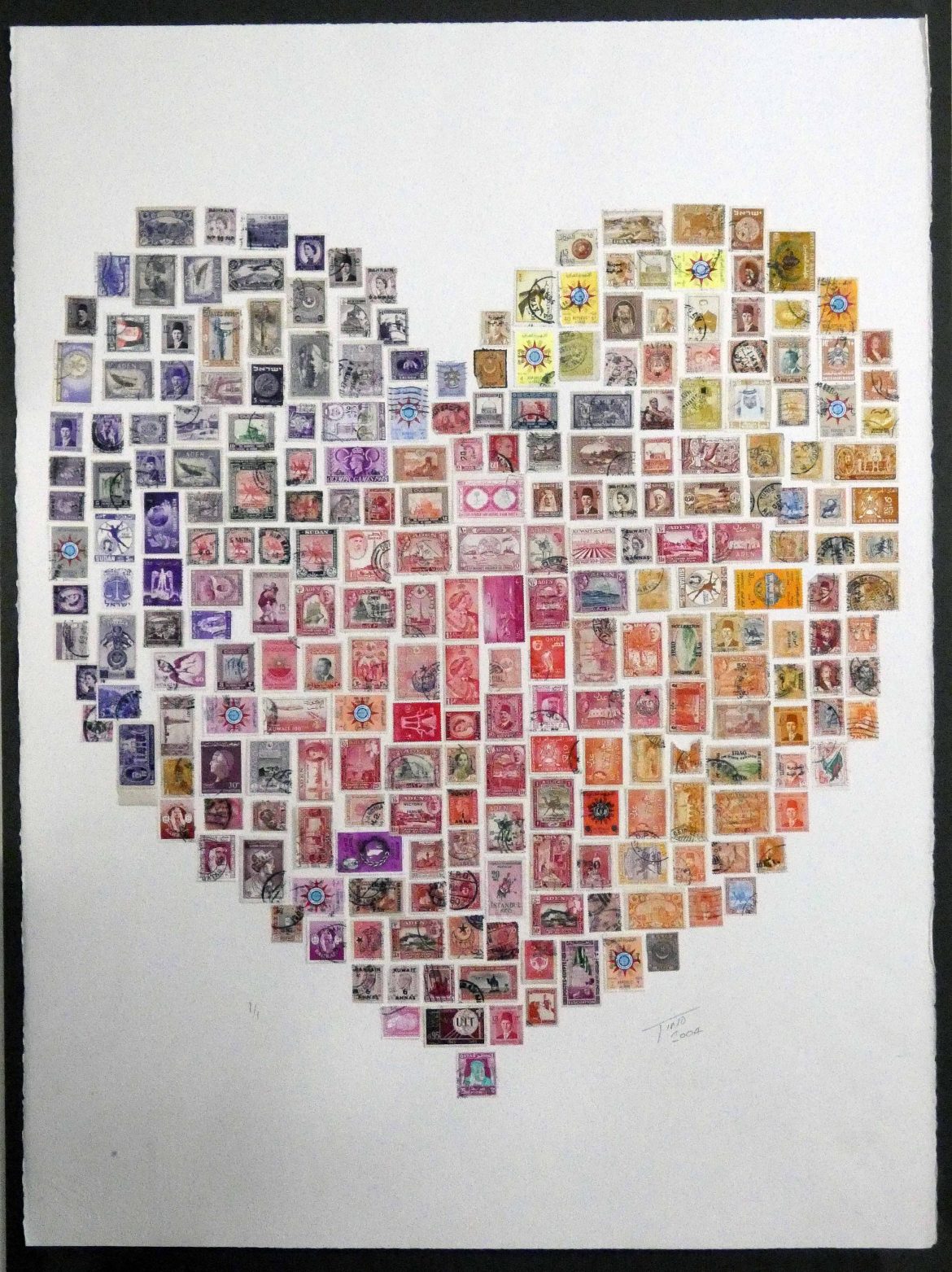
The Stamp Art 2004 ‘Hearts‘ project of Mint & used world stamps 1971 to 1983, presents an informative and educational showcase of the Hearts of Arabia focus’s on the metaphor and spiritual connection with the meaning and colours of hearts. These are presented in Artwork Layouts with a number of ‘Limited Edition’ Fine Artwork prints for sale in the Stamp Art Gallery Shop.
The combination of the heart shape and its use within the heart metaphor developed by the end of the Middle Ages, although the shape has been used in many ancient epigraphy monuments and texts. With possible early examples or direct predecessors in the 13th to 14th century, the familiar symbol of the heart representing love developed in the 15th century, and became popular in Europe during the 16th.

Origins of the Heart Symbol
The first known depiction of a heart as a symbol of romantic love dates to the 1250s. It occurs in a miniature decorating a capital ‘S’ in a manuscript of the French Roman de la poire (National Library FR MS. 2086, plate 12). In the miniature a kneeling lover (or more precisely, an allegory of the lover’s “sweet gaze” or douz regart) offers his heart to a damsel. The heart here resembles a pine cone (held “upside down”, the point facing upward), in accord with medieval anatomical descriptions. However, in this miniature what suggests a heart shape is only the result of a lover’s finger superimposed on an object; the full shape outline of the object is partly hidden, and therefore unknown. Moreover, the French title of the manuscript that features the miniature translates into “Novel Of The Pear” in English. Thus the heart shaped object would be a pear; the conclusion that a pear represents a heart is dubious. Opinions therefore differ over this being the first depiction of a heart as symbol of romantic love. Giotto in his 1305 painting in the Scrovegni Chapel (Padua) shows an allegory of charity (caritas) handing her heart to Jesus Christ. This heart is also depicted in the pine cone shape based on anatomical descriptions of the day (still held “upside down”). The convention of showing the heart point upward switches in the late 14th century and becomes rare in the first half of the 15th century.

Miniature decorating a capital ‘S’ in a manuscript of the French Roman de la poire
The “scalloped” shape of the now-familiar heart symbol, with a dent in its base, arises in the early 14th century, at first only lightly dented, as in the miniatures in Francesco Barberino’s Documenti d’amore (before 1320). A slightly later example with a more pronounced dent is found in a manuscript from the Cistercian monastery in Brussels (MS 4459–70, fol 192v. Royal Library of Belgium). The convention of showing a dent at the base of the heart thus spread at about the same time as the convention of showing the heart with its point downward. The modern indented red heart has been used on playing cards since the late 15th century.

Miniatures in Francesco Barberino’s Documenti d’amore
Various hypotheses attempted to connect the “heart shape” as it evolved in the Late Middle Ages with instances of the geometric shape in antiquity. Such theories are modern, proposed from the 1960s onward, and they remain speculative, as no continuity between the supposed ancient predecessors and the late medieval tradition can be shown. Specific suggestions include: the shape of the seed of the silphium plant, used in ancient times as an herbal contraception and stylized depictions of features of the human female body, such as the female’s breasts, buttocks, pubic mound, or spread vulva.

Seed of the Silphium Plant
Stamp Art: The ‘Hearts’ project – 2004
The use of various world stamps with cancellations and splendid colours, reveal their own stories and metaphors in The Stamp Art ‘Hearts’ project collection. Each piece has been hand chosen and placed to create a unique hand made emphasis to add to the meaning of creating these pieces of art using postage stamps from around the world.

2004 Launch ‘Hearts‘ project
The Red Heart
MINT & Used world postage stamps of significance and colour.
Size: 56cm x 81cm
Created as a focal piece of stamp artwork using stamps from around the world. Working in pastel and deep shades The Red Heart is a personal expression of the way the artist felt people would connect with the colour of ‘Hearts’. By Tino

2004 Launch ‘Hearts‘ project
The Green Heart
MINT & Used world postage stamps of significance and colour.
Size: 56cm x 81cm
Created as a focal piece of stamp artwork using stamps from around the world. Working in pastel tones and deep shades The Green Heart is a personal expression of the way the artist felt people would connect with the meaning of ‘Hearts’. By Tino

2004 Launch ‘Hearts‘ project
The Flowers of Hearts
Ajman – Fujeira – Manama – Umm-al-Quwain – MINT & Fine Used postal issues
Size: 56cm x 81cm
Created as a support piece of stamp artwork using stamps from around the middle east, renowned for the spirit of Heart. Working with high quality pictorial thematic stamps displaying flowers in shades of red and yellow blended with stamps of picasso and the female nude subject as the focus of the Heart. The Flowers Heart is a personal expression of the way the artist felt people would connect with the deep sense and emotion of ‘Hearts’. By Tino

2004 Launch ‘Hearts‘ project
The Love of Hearts
Kingdom of Bahrain postage stamps – MINT
Size: 56cm x 81cm
Created as a support piece of stamp artwork using stamps from around the middle east, renowned for the spirit of Heart. Working with high quality pictorial thematic stamps displaying the rich colours of the heart. The Love of Hearts is a personal expression of the way the artist felt people would connect with the deep sense of emotion evoked by images of ‘Hearts’. By Tino

2004 Launch ‘Hearts‘ project
The Nature of Hearts
Mint & Used world postage stamps of significance and colour.
Size: 56cm x 81cm
Created as a support piece of stamp artwork using stamps from around the world and middle east, renowned for the spirit of Heart. Working with high quality pictorial thematic stamps displaying butterfly’s and horses in shades of reds, yellow, green and blue, blended with pastel stamps to surround the heart. The Nature of Hearts is a personal expression of the way the artist felt people would connect with the changing moods of ‘Hearts’. By Tino
Conclusion
The Stamp Art Hearts project is inspired by ‘Hearts of Arabia’, most commonly referring to the Heart of Arabia expedition, an expedition that retraced the route of Harry St. John (Abdullah) Philby’s 1917 journey across Saudi Arabia. The expedition, which began on November 15th at Al Uqair, aimed to cover 1,300 km on foot, by camel, and by 4×4 vehicle, following Philby’s original route and also exploring areas he visited later in his life. Philby’s journey and writings about it earned him the Royal Geographical Society Founder’s Medal.
The term “Hearts of Arabia” can also be connected to the broader context of British involvement and exploration in Arabia during the early 20th century, including the work of T.E Lawrence (Lawrence of Arabia). Lawrence, a British intelligence officer, played a key role in the Arab Revolt against the Ottoman Empire during World War 1.
Private commission for exhibition’s and corporate display, in large format artworks with accompanying messaging are available by request. Please contact info@stampartist.co.uk. for more information.
Fine Art Limited Edition & Numbered Prints
Visit The Stamp Art Shop to Explore A full range of
Fine Art Limited Edition Prints for sale.
Click the Image to go to the Shop.
* Original Stamp Artworks.
* Unique Fine Art Stamp Art Reproductions.
* Stamp Artworks with Fine Mint Stamps within the Artworks.
shop.stampartist.co.uk