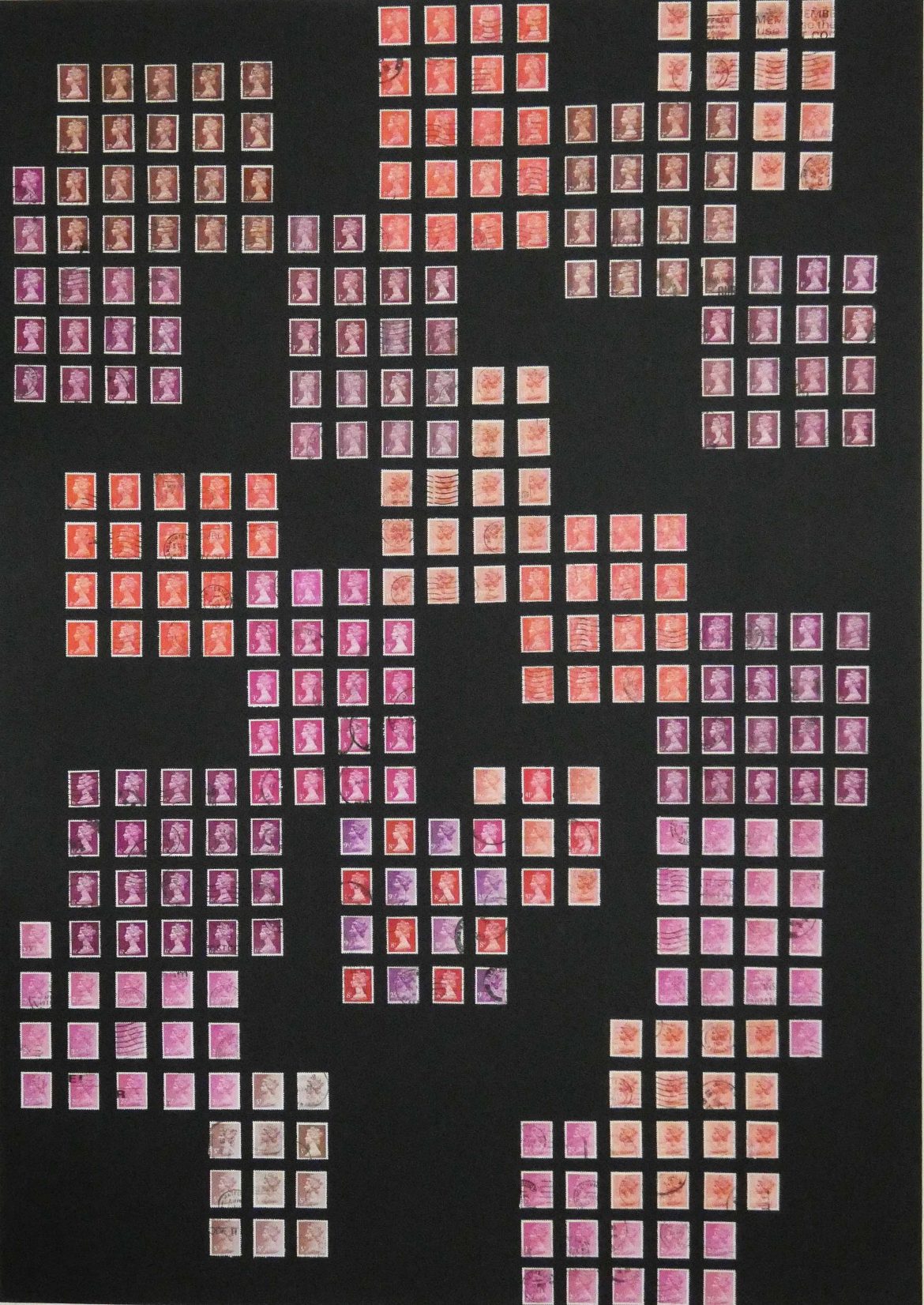
The Stamp Art 2004 Reflection of The 70’s ‘Rain’ project presents an informative and educational showcase on use of ‘Decimal’ postage stamps used to create meaningful artworks for display. These are presented in Artwork Layouts with a number of ‘Limited Edition’ Fine Artwork prints available to sale in the Stamp Art Gallery Shop.
A Stamp Art project focusing on The 1970’s Contemporary Art movement, reflected in the colours of the 70’s using GB postage stamp issues of pre and post decimalisation, and the introduction of a new monetary system.
The 1970s (pronounced “nineteen-seventies”; shortened to “the ‘70s“) was a decade of the Gregorian calendar that began on January 1, 1970, and ended on December 31, 1979. It was the eighth decade of the 20th Century.
The Civil Rights Movement of the 1960s began to fracture in the 1970s, as social groups began defining themselves more by their differences than by their universalities. The Black Nationalist movement grew out of frustrations with the “non-violent” strategies of earlier Civil Rights Activists.
The feminist movement also splintered from a larger push for Civil Rights in the 1970s. The seventies were seen as the “woman’s turn”, though many feminists incorporated civil rights ideals into their movement. Similarly, the gay movement made a huge step forward in the 1970s with the election of political figures such as Harvey Milk to public office and the advocating of anti-gay discrimination legislation passed and not passed during the decade. Many celebrities, including Freddie Mercury and Andy Warhol, also “came out” during this decade, bringing gay culture further into the limelight.
THE CONTEMPORARY ART STYLES OF THE 1970s
The 1970s decade was characterized by environmentalism, women’s liberation, rock and roll, and plenty of bold fads. From bright colours and wild patterns to outlandish inventions, the ‘70s were anything but quiet. And the art scene was no exception. To give you a better idea, here’s a look into some of the bold, unique art styles of the 1970s.
BAD PAINTING
“Bad” Painting was a style of American figurative painting popularized in the late 1970s. The “Bad” Painting movement took place in New York and can be defined as a rejection of traditional art styles. Talented artists threw the conventional rules of art out the window and created pieces that were often humorous, cynical, or cartoonish.

FEMINIST ART
With the American Feminist Movement in full swing, the 1970s introduced us to a style of art called Feminist Art. During this time, women sought to expose gender inequality not just in the art world, but in society. The art movement centered around women’s lives and experiences, seeking to redefine modern art. Women used photography and other art forms to draw attention to the objectification of women in art and society.

FUNK ART
An American art movement, Funk Art was especially popular in Northern California. Artists were inspired by the beatnik culture, political activism, and free thinking. This art style often incorporated the theme of self-identification—creative freedom, humour, vulgarity, irony and often ambiguity. Artists were likely to use found objects in their art or to create non-functional ceramic art.

LOWBROW ART
A visual art movement in Los Angeles, Lowbrow Art came to fruition in the late 1970s. Artists drew inspiration from punk music, underground comix, and hot-rod culture. With painting as the most common medium, Lowbrow Art is often characterized as being humorous or sarcastic. Though not seen as “fine art” at the time, Lowbrow Art of the 1970s is often sought out by collectors.

PHOTOREALISM
Very different from some of the above forms, Photorealism was an art movement beginning in the 1960s and making waves into the 1970s. Artists would first take a photograph of a scene, develop it, and then transfer it onto canvas using paint. This resulted in paintings that could be easily mistaken for actual photographs.
The Stamp Art – Reflection of the 1970’s ‘Rain’ project focuses the use of GB Postage Stamps to reflect the colours of the time in a Contemporary Modern Art collection associated with the movement of the 70’s. The pieces can be viewed close up or from a distance to gain the perspective of ‘Rain’ falling as if were framed inside a window.

The Stamp Art – Reflection of the 1970’s ‘Rain’ project
focuses the use of GB Postage Stamps to reflect the colours of the time in a Contemporary Modern Art collection associated with the movement of the 70’s. The pieces can be viewed close up or from a distance to gain the perspective of ‘Rain’ falling as if were framed inside a window.

2004 Launch ‘Rain” project
The Red Rain Falls
Size: 56cm x 81cm

2004 Launch ‘Rain‘ project
The Blue Rain Falls
Size: 56cm x 81cm

2004 Launch ‘Rain‘ project
The Green Rain Falls
Size: 56cm x 81cm

2004 Launch ‘Rain‘ project
The Brown Rain Falls
Size: 56cm x 81cm

2004 Launch ‘Rain‘ project
The Dirty Rain Falls
Size: 56cm x 81cm

2004 Launch ‘Rain‘ project
The Black & Blue Rain Falls
Size: 56cm x 81cm

2004 Launch ‘Rain‘ project
The Ruby Rain Falls
Size: 56cm x 81cm

2004 Launch ‘Rain‘ project
The Georgian Rain Falls
Size: 56cm x 81cm
Conclusion
The Stamp Art ‘Rain’ project uses decimal postage stamps which is a stamp with a value expressed in a decimal currency system, specifically using pounds and pence (or cents) rather than the older pounds, shillings, and pence system. In the UK, decimal stamps were introduced as part of the country’s transition to decimal currency in 1971.
The UK switched to a decimal currency system on February 15, 1971, commonly known as “D-Day”. This meant that the pound was divided into 100 new pence (p), making calculations simple. Before decimalization, the UK used a system where one pound (£) consisted of 20 shillings (s), and one shilling consisted of 12 pence (d), making a total of 240 pence in a pound.
Private commission for exhibition’s and corporate display, in large format artworks with accompanying messaging are available by request. Please contact info@stampartist.co.uk. for more information.
Fine Art Limited Edition & Numbered Prints
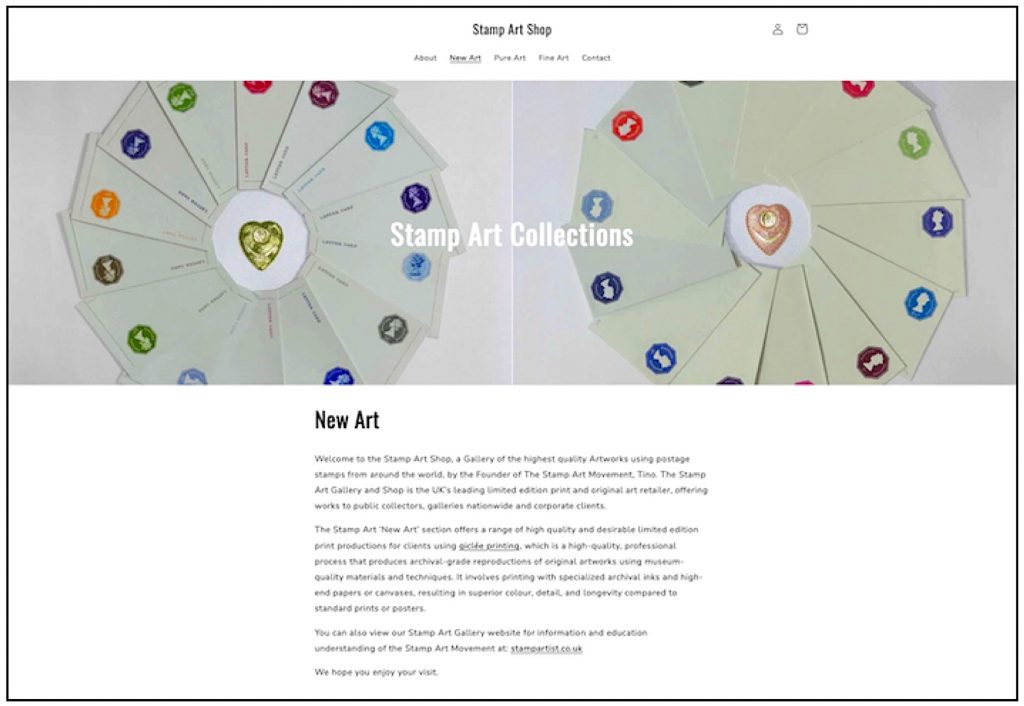
Visit The Stamp Art Shop to Explore A full range of
Fine Art Limited Edition Prints for sale.
Click the Image to go to the Shop.
* Original Stamp Artworks.
* Unique Fine Art Stamp Art Reproductions.
* Stamp Artworks with Fine Mint Stamps within the Artworks.
shop.stampartist.co.uk