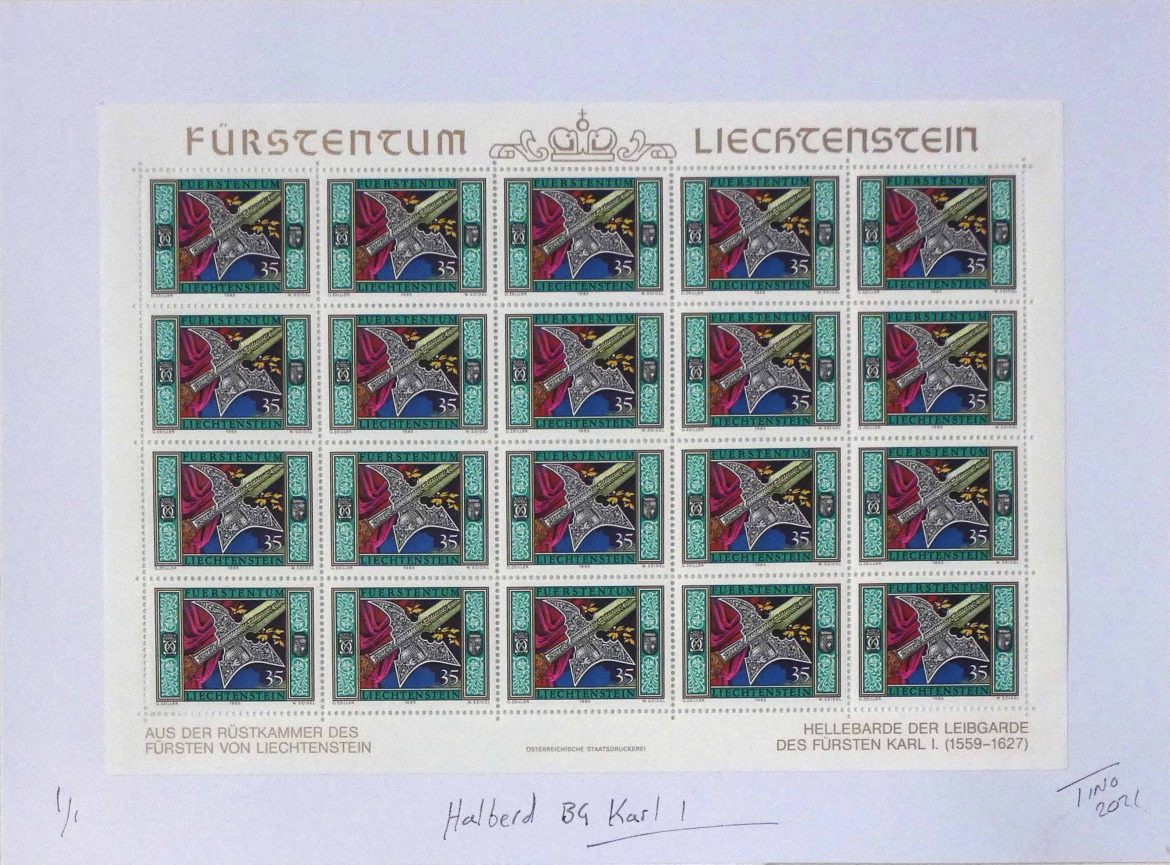
The Stamp Art Liechtenstein ‘Body Guard’ project, presents an informative and educational review of Halberd for the Bodyguard of Karl Eusebius, Prince of Liechtenstein issues which are unique in their display of story telling, presented in Artwork Layouts with a number of ‘Limited Edition’ Fine Artwork prints available for sale in the Stamp Art Gallery Shop.
Karl Eusebius (April 11, 1611 – April 5, 1684) was the Prince of Liechtenstein. He inherited this title in 1627 from his father Karl I. He was 16 and thus considered underage, and his uncles Prince Gundakar and Maximillian acted as regents until 1632. From 1639 to 1641 Karl was Chief Captain of High and Low Silesia. After the Thirty Years’ War Karl effectively restored his dominions economically.
Pole arms (staff weapons) were used not only in warfare and hunting, but also in sporting combat and ceremonies. The term refers to a family of edged weapons attached to wooden staffs. With the exception of the lance, which remained the weapon of the mounted knight, all other staff weapons were wielded by men on foot by 1600.

Karl Eusebius – Halberd
With the development of firearms and their introduction as infantry weapons, pole arms lost their importance on the field, and from the mid-16th century, they were reserved for use in sporting contests and by princely bodyguards for ceremony and parade. The blades lent themselves to embellishment—engraving, etching, or other forms of decoration—and provided a perfect surface for the coats of arms of noble or princely families. The ceremonial use of staff weapons continues to this day with the Swiss Guards at the Vatican and Britain’s Yeomen of the Royal Guard.

Karl Eusebius – Birnmorian
Morian (helmet)A morion (Spanish: morrión) is a type of open helmet originally from the Kingdon of Castile (Spain),used from the beginning 16th to early 17th centuries, usually having a flat brim and a crest from front to back. Its introduction was contemporaneous with the exploration of North, Central and South America. Explorers such as Hernando de Soto and Coronado may have supplied them to their foot soldiers in the 1540s.

The Liechtenstein ‘Body Guard’ project
Halberd BG Karl I
The halberd head––consisting of an axe blade with strongly concave cutting edge, a wide double-edged thrusting blade with strong mid-ridge, and a down-curved apical beak––is almost completely covered with etched decoration. On one side of the axe blade is etched the arms of the Princes Liechtenstein, and on the other an oval medallion with the emblem of a hammer-wielding hand striking a pointed anvil, the personal device of Carl Eusebius (1611–1684), Prince of the Empire and Regent of the House of Liechtenstein, and the inscription VIRTUTE ELUDITUR ICTUS (“Through virtue he eludes the blow”).

Birnmorian
Adopted by the Swiss to protect their royalty and in battle, the Birnmorian (Helmet) was worn not just by the army but by all Swiss residents and residents of principalities to protect their nation, as today all Swiss residents have use of their firearms as part of their national security strategy.

Halberd BG Carl Eusebius
Pole arms (staff weapons) were used not only in warfare and hunting, but also in sporting combat and ceremonies. The term refers to a family of edged weapons attached to wooden staffs. With the exception of the lance, which remained the weapon of the mounted knight, all other staff weapons were wielded by men on foot by 1600. With the development of firearms and their introduction as infantry weapons, pole arms lost their importance on the field, and from the mid-16th century, they were reserved for use in sporting contests and by princely bodyguards for ceremony and parade.
The ceremonial use of staff weapons continues to this day with the Swiss Guards at the Vatican and Britain’s Yeomen of the Royal Guard.
Conclusion
Karl Eusebius (11 April 1611 – 5 April 1684)was the Prince of Liechtenstein. He inherited this title in 1627 from his father Karl I. He was 16 and thus considered underage, and his uncles Prince Gundakar and Maximillian acted as regents until 1632. From 1639 to 1641 Karl was Chief Captain of High and Low Silesia.
From the economic point of view, Karl Eusebius has the merit of reconstructing the Liechtenstein dominions devastated in the Thirty Years’ War and of maintaining them in times of trouble. Karl was also an extensive patron of architecture of the period.He formed the early plans for Plumlov Castle, which in fact his son the future Hans-Adam I oversaw the construction of.
Liechtenstein’s postal stamps are famous for their exceptional artistry, high aesthetic value, and status as a vital part of the nation’s economy and identity. Since issuing its first stamp in 1912, the principality has built a worldwide reputation among collectors for masterful engraving and unique designs.
Private commission for exhibition’s and corporate display, in large format artworks with accompanying messaging are available by request. Please contact info@stampartist.co.uk. for more information.
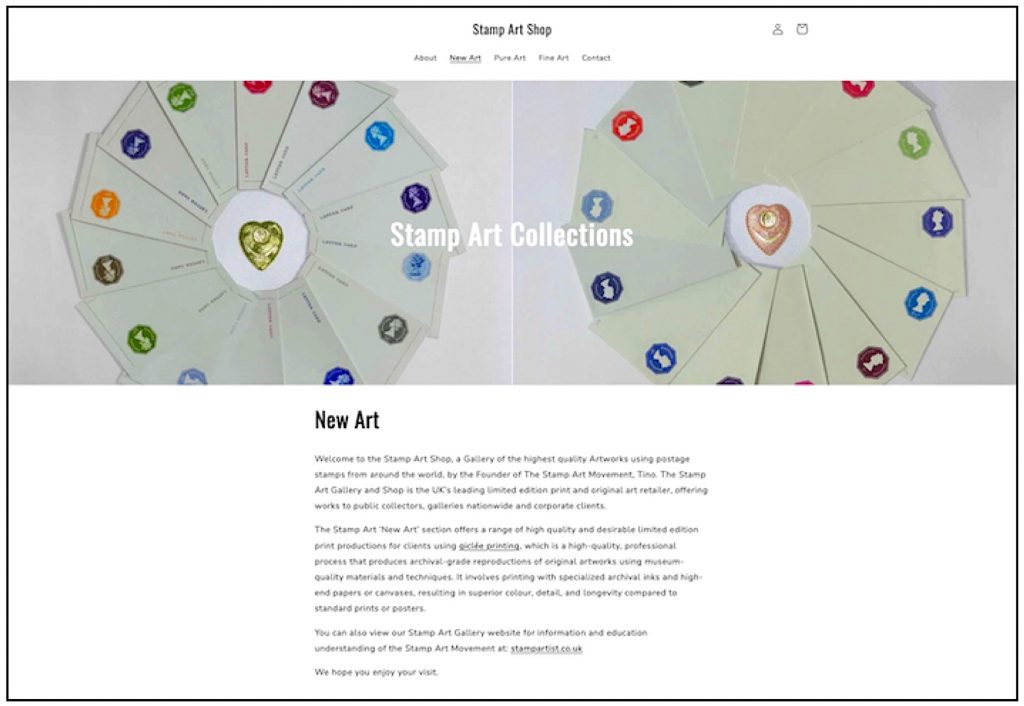
Fine Art Limited Edition & Numbered Prints
Visit The Stamp Art Shop to Explore A full range of
Fine Art Limited Edition Prints for sale.
Click the Image to go to the Shop.
* Original Stamp Artworks.
* Unique Fine Art Stamp Art Reproductions.
* Stamp Artworks with Fine Mint Stamps within the Artworks.
shop.stampartist.co.uk