

The Stamp Art GB 1966 3d – 4d – 6d – 1s – Battle of Hastings issue – MINT with Errors and Varieties. This showcase, presents an informative and educational review in one Artwork Layout from which a selected number of ‘Limited Edition’ Fine Artwork prints to be released and available for sale in the Stamp Art Gallery Shop.
The Stamp Art GB 1960’s Full ‘Sheets’ of Postal Stamps – Very Rare and Limited Edition, World Full & Half ‘Sheets’ of Postal Stamps with Errors and Varieties of postal overprinting – MINT Condition.
The Battle of Hastings was fought on 14 October 1066 between the Norman-French army of William, the Duke of Normandy, and an English army under the Anglo-Saxon King Harold Godwinson, beginning the Norman conquest of England. It took place approximately 7 mi (11 km) northwest of Hastings, close to the present-day town of Battle, East Sussex, and was a decisive Norman victory.

The background to the battle was the death of the childless King Edward the Confessor, in January 1066, which set up a succession struggle between several claimants to his throne. Harold was crowned king shortly after Edward’s death, but faced invasions by William, his own brother Tosig, and the Norwegian King Harald Hardrada (Harold III of Norway). Hardrada and Tostig defeated a hastily gathered army of Englishmen at the Battle of Fulford on 20 September 1066, and were in turn defeated by Harold at the Battle of Stamford Bridge five days later. The deaths of Tostig and Hardrada at Stamford Bridge left William as Harold’s only serious opponent. While Harold and his forces were recovering, William landed his invasion forces in the south of England at Pavensey on 28 September 1066 and established a beachhead for his conquest of the kingdom. Harold was forced to march south swiftly, gathering forces as he went.

The exact numbers present at the battle are unknown as even modern estimates vary considerably. The composition of the forces is clearer; the English army was composed almost entirely of infantry and had few archers, whereas only about half of the invading force was infantry, the rest split equally between cavalry and archers. Harold appears to have tried to surprise William, but scouts found his army and reported its arrival to William, who marched from Hastings to the battlefield to confront Harold. The battle lasted from about 9 am to dusk. Early efforts of the invaders to break the English battle lines had little effect; therefore, the Normans adopted the tactic of pretending to flee in panic and then turning on their pursuers. Harold’s death, probably near the end of the battle, led to the retreat and defeat of most of his army. After further marching and some skirmishes, William was crowned as king on Christmas Day 1066.

The story of the stamps to mark the 900th anniversary of the Battle of Hastings began with a letter of 5 November 1962 to the Postmaster General (PMG) from the ‘1966 Celebrations Council’, constituted in Hastings to prepare events to celebrate the anniversary. The letter suggested that ‘this famous anniversary in the history of our country’ be commemorated by stamps. The reply from the GPO, dated 9 November, was non-committal. The Council was informed that the policy regarding special stamps confined them to ‘outstanding current national or international events and Royal and postal anniversaries’. Even though the Battle of Hastings resulted in the death of the last Saxon King of England and marked the beginning of the Norman Monarchy, the 900th anniversary was clearly seen by the GPO as an historical, rather than royal, anniversary. Such anniversaries were excluded by the policy unless of outstanding historical importance and marked by notable current events. The GPO therefore asked to be kept informed of the events the Council.
The Battle of Hastings is certainly one of England’s most memorable points in English History due to its important part in the Norman Conquest of England. The battle is displayed to show the wonderful design and use of colours, while taking on the military form of The Norman Conquest. The Battle of Hastings vGB75a uses mint GB issue stamps with printer pagination colour bar and the ‘Yellow Queens Head’ error, seen in the top right corner stamp.
The Stamp Art ‘Battle of Hastings’ project focuses on High Quality Presentation, Unique colour mix with the Queens Gold Head and the vivid variety of colours of the stamps, displayed in a battle format using blocks as art works capturing the intensity of the conquest in a Modern Artwork format. The MINT quality of the blocks and the varieties with gold head ‘colour’ errors and ‘traffic lights’ used by the printers show of the Artwork to its highest quality.

The ‘Battle of Hastings’ project
GB Battle of Hastings SG 708-710 (Yellow Gold Head Shift) top right stamp
GB Battle of Hastings SG 708-710 Mint issued stamp below
The name reference vGB75A is unique to the artist
Conclusion
The Stamp Art Battle of Hastings project, displays a focus on a pivotal event in English history, took place on October 14, 1066, near the present-day town of Battle, East Sussex. It pitted the Norman forces led by William the Conqueror against the English army under King Harold Godwinson. The battle resulted in a decisive Norman victory, leading to the Norman Conquest of England and significantly altering the course of English history.
The ‘Battle of Hastings’ was one of the most important pivotal events in English History and is a focus for Tino the Stamp Artist who is working on an exciting new Artwork Exhibition with The Stamp Art Gallery for the public to enjoy, with a number of Collectors Limited Edition Prints including postage stamps to be released. Please check The Stamp Art Shop for updates and information on this exciting release.
Private commission for exhibition’s and corporate display, in large format artworks with accompanying messaging are available by request. Please contact info@stampartist.co.uk. for more information.
Fine Art Limited Edition & Numbered Prints
Visit The Stamp Art Shop to Explore A full range of
Fine Art Limited Edition Prints for sale.
Click the Image to go to the Shop.
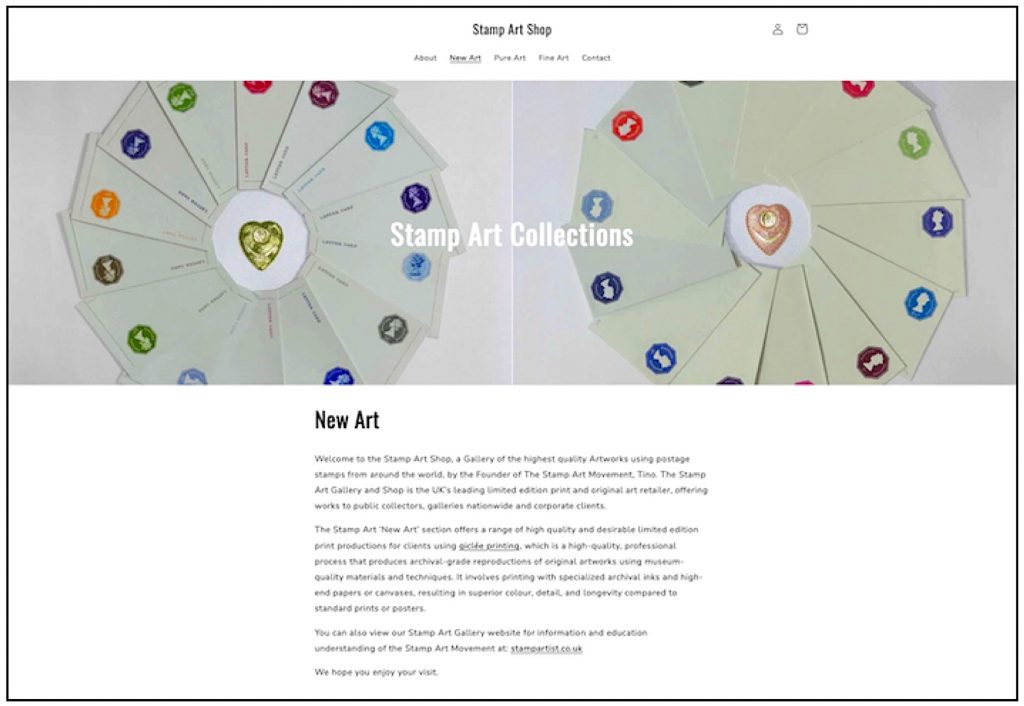
* Original Stamp Artworks.
* Unique Fine Art Stamp Art Reproductions.
* Stamp Artworks with Fine Mint Stamps within the Artworks.
shop.stampartist.co.uk